Saturday, October 20, 2012

Rufous & Ruby-throated Hummingbirds!

<This post was originally about just Ruby-throated Hummingbirds, but I heavily edited it with the more important news below>

"It" happened much sooner and with much less effort than I thought possible -- a Rufous Hummingbird visited my backyard!

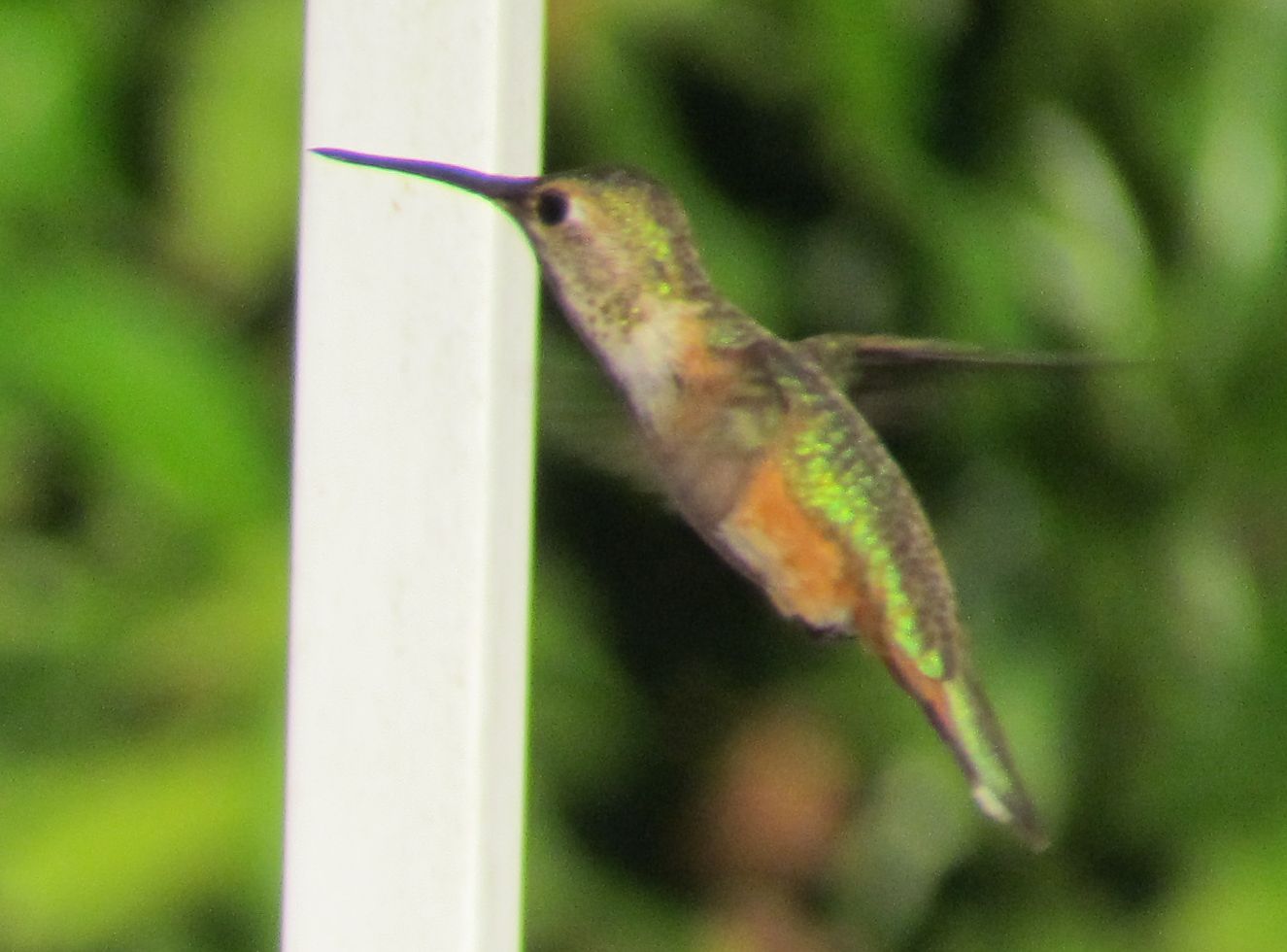
The date was October 22nd a little after 5 o'clock in the evening.  Two Ruby-throated Hummingbirds had been visiting the hummingbird feeder in the backyard for weeks.  I happened to notice a lot of furious motion by the feeder and took a closer look.  A new hummingbird was present and was aggressively defending the feeder from the Ruby-throats.  Here's what I saw:

Rufous Hummingbird in my Wilmington, NC backyard, October 22 2012.  Note the rufous color (fancy word for "brown") extending down the sides of the tail, the key field mark for this species.

Rufous Hummingbird.  Wilmington, NC.  October 22 2012

Rufous Hummingbird on the right, Ruby-throated Hummingbird on the left.  Wilmington, NC.  October 22 2012.

Ruby-throated Hummingbird on the feeder, Rufous Hummingbird hovering to the left.  The Rufous Hummingbird is much more aggressive than the Ruby-throated birds and had a 100% success rate chasing them away from the feeder.

A good look at the brown undertail on my Rufous Hummingbird.

As the sun was setting, my wife Jaime took some excellent photos of the Rufous Hummingbird using a flash for illumination.

Probably the best photo taken of our Rufous Hummingbird.  Wilmington, NC.  October 22 2012.

Unfortunately the Rufous Hummingbird didn't hang around too long.  After just two days she departed our backyard for parts unknown.  It's always possible she'll be back, so I plan to keep a feeder stocked up with sugar water for her through the winter months ahead.  The Ruby-throated Hummingbirds were all too happy to have the Rufous bird gone as some peace has returned to the backyard.

A Ruby-throated Hummingbird, hanging out in my Wilmington, NC backyard in late October.  The black patch on her neck is probably worn feathers from the rough rim of her nest earlier in the year.

So now that I've seen a Rufous Hummingbird, what's next on my list of rarities?   I'd love to see a Black-chinned Hummingbird:  they're rare in North Carolina but have been observed before.  In fact just last winter one spent a good portion of the winter on the south side of Wilmington as shown by the numerous eBird reports here:
eBird reports of a Black-chinned Hummingbird wintering in
Wilmington, NC during the winter of 2011-2012


Friday, October 19, 2012

Tonight's Crescent Moon

Tonight's Moon is one-quarter full which makes, in my opinion, some of the prettiest lunar photography.  The terminator (day/night line) on the moon's surface shows the most topographic detail since the sun angle is nearly horizontal.  This makes mountains and valleys show up with amazing clarity.


These pictures were not taken using a telescope -- just a consumer-grade Canon digital camera mounted on a tripod.  I used a variety of exposure times ranging from 15 seconds to 1/1600th of a second to accentuate different details.  The longer exposures show earthshine, light reflected off the daytime side of the earth illuminating the dark, nighttime side of the moon.  This is doubly-reflected sunlight that first reflected off the bright daytime side of the Earth, then the dark portion of the moon, then back to our eyes on the Earth again!  These long-exposure photos are also blurred due to the rotation of the earth producing apparently movement of the moon across the sky.

Mid-range exposures show a balanced view much like the human eye perceives.  Short exposure settings reveal details on the daytime side of the moon that would otherwise be drowned out by the bright surface there.

Monday, October 1, 2012

October Hummingbirds

The only hummingbird I've seen is the Ruby-throated Hummingbird.  If you live in the eastern half of the United States that may be the only one you've seen, too.  Here on October 1st I've still got two of these beautiful birds inhabiting my backyard.

Ruby-throated Hummingbird on my backyard feeder, October 1, 2012.

Obviously they're most attracted to my backyard hummingbird feeder.  They're also spending time visiting my Japanese Honeysuckle, Mexican Hummingbird bush, and some of the Cannas that are still blooming.  Notice red on the hummingbird feeder and on the flowers?  Hummingbirds are strongly attracted to the color red.  One of my bird identification guide books includes an anecdote stating Ruby-throated Hummingbirds have been killed when attempting to "feed" from red plastic insulators on electric fences.

Canna flowers, October 1, 2012.   They're much
prettier earlier in the year.
A few late flowers on my Mexican Hummingbird Bush,
October 1, 2012

Over the past 10 years or so there has been an increasing number of hummingbirds reported in the eastern United States during the fall or winter.  Primarily these reports are of the Ruby-throated Hummingbird and the Rufous Hummingbird, but more exotic species are showing up as well including the Calliope Hummingbird and the Black-chinned Hummingbird, among others.  Why is this happening?  Not being an expert myself I can only repeat what I've read elsewhere -- more and more people maintaining hummingbird feeders through the Fall and Winter months is probably the primary reason.  Climate change is also cited as a possible reason, but the winters of 2009-2010 and 2010-2011 were some of the coldest in the past 130+ years over the southeastern United States, yet both years had relatively large numbers of vagrant hummingbirds spending the winter here.

My feeling is the increasing number of feeders being maintained year-round, and the increasing number of people using the Cornell University eBird website to share their sightings are responsible for the apparent increase in the numbers of winter hummingbirds in the eastern United States.  Many hummingbirds undoubtedly have failed to locate their wintering grounds in Mexico and Central America for millennia, instead heading into the eastern U.S.  With few native plants flowering during the winter and few insects available to eat, these birds would have all starved -- until now.

The odds are certainly stacked against me, but my goal is to somehow attract one of these vagrant hummingbirds to my backyard this winter.  Or at least keep one of the Ruby-throated Hummingbirds I've already got.  We'll see...

Output graph from Cornell University's eBird database as of October 1, 2012 for nine counties across
Southeastern North Carolina.  The plot shows the frequency of all eBird checklists that include at least
one Ruby-Throated Hummingbird.  The high number of birds seen during the winter is partially due
to observational bias (when someone sees a hummingbird in winter they are MUCH  more likely to
file a report) but it also indicates that the birds are here in fairly substantial numbers during the winter.
To see an updated version of the graphic above using live data from eBird, click this link.

Sunday, September 30, 2012

Changsha Mandarins: Their Fruit and Their Pests

About four years ago I planted three Changsha Mandarins in my backyard.  Changsha Mandarins (one of the many varieties within Citrus reticulata) are one of the cold hardiest of the citrus family that do not have any Poncirus or Ichangensis in their bloodline.  While this reduces the Changsha's survival in truly cold winter climates, it also means there will be none of the characteristic skunkiness or insipid, puckering flavors that sometimes go hand-in-hand with the entire notion of cold-hardy citrus.

Compared to Satsumas (which otherwise share many of the Changsha's characteristics) my Changsha Mandarins are tall, upright trees, very different from the drooping shape of the Satsumas.  Their vertical growth has been nothing short of spectacular as seen in the photos below:
Changsha Mandarin in 2009.  Total height
about 1.5 feet tall.  It was moved from a
pot to the ground in early April.
Changsha Mandarin in 2010.  Total height
about 3 feet.  It's still mainly a single
shoot at this point, with a few side-
branches just forming.
Changsha Mandarin in 2011.  Total height
about 7 feet.  The single vertical branch
is starting to divide out into multiple
branches.


Changsha Mandarin in 2012.  Total height
about 11 feet.  This particular tree has
17 fruits on it, its first crop ever!


This Spring (2012) I observed flowers covering all three of my Changsha Mandarins, and many of the flowers successfully set fruit.  I was initially disappointed at what appeared to be the small number of fruit on the trees, but as summer wore on I discovered dozens more fruit than I initially saw during the spring.  Now here at the end of September as the fruit are beginning to acquire their first hints of orange color, I can easily count them:  there are 52 covering the three trees.


My first crop of Changsha Mandarins!  Late September 2012.
Since I'm still about a month away from sampling my first Changsha Mandarins I can't give any first-hand experiences with the fruit yet.  The largest are just a bit smaller than tennis balls.  Here's the description from the website of the nursery I bought them from, Woodlanders in Aiken, South Carolina:  "It is a hardy and early fruiting citrus here in Aiken, SC with fruit which is much relished by neighborhood kids!"  

At the Southeastern Palm Society's Citrus Expo held here in Wilmington in November 2010 I had the pleasure of actually meeting up with some folks from Woodlanders Nursery, and I asked them about their Changshas in particular.  I was assured their trees produced excellent, although sometimes seedy fruit.  I look forward to confirming this next month!  Note: All of the citrus from Woodlanders Nursery is grown on its own roots.  This means without a dwarfing rootstock you're likely to get a very large tree as the years ago by.  Plan accordingly!

Changsha Mandarins, as with all citrus, have a few pests you've really got to watch out for.  Here in North Carolina, several hundred miles north of the Florida or Gulf Coast citrus industry, our insect and disease pressures are much lower than backyard or hobbyist growers to my south might endure.  The three insect pests I've observed here are the Citrus Leafminer, Red Citrus Spider Mites, and several varieties of Aphids.


Citrus Leafminer damage.  The
tiny caterpillar inside the leaf
causes the shiny U-shaped trails.
The Citrus Leafminer is active only during the warm, growing season.  The adults are small, unimpressive moths that blend in really well with any of the dozens of moth species you might see flying around streetlights and porch lights at night.  The adults lay their eggs on tender new growth.  The eggs hatch into tiny caterpillars that tunnel inside the new leaves, leaving a very characteristic shiny trail behind that doubles back on itself many times in U-shaped channels as they consume the tasty, inner portion of the leaf.  In most cases the damage they cause isn't severe and probably only becomes a major issue on small or otherwise unhealthy trees.  For control of Citrus Leafminers I visually inspect new shoots every couple of days during the growing season and just pull off and safely dispose of any affected leaves.  If you catch them early enough this should prevent a major outbreak.  I went three years without seeing a single Citrus Leafminer using this method!  Obviously this would not work as in areas near commercial citrus plantings or where nearby neighbors are growing citrus.  Chemical-based or pheromone-based control techniques might work better then.
When a Citrus Leafminer caterpillar is ready to pupate it rolls over a section of leaf and seals it with silk.
These are very important to remove and destroy if you're wanting to exercise chemical-free control of these pests.


The only picture I could find I've taken of Red Citrus
Spider Mites.  There are a few individuals on the leaf
behind the flower buds, and a few more above.
Red Citrus Spider Mites are, at least in my backyard, almost exclusively a Winter and early Spring pest.  They can multiply to astounding numbers during the winter and can heavily damage leaves by their sucking of sap and subsequent dehydration of the leaves.  Interestingly they don't appear to be affected by freezing temperatures even down to 20 degrees F. (-6.5 degrees C)  They congregate most-heavily on the upper surfaces of the leaves but also appear on the lower surfaces in smaller numbers -- look for tiny red dots a little smaller than grains of sand.  If you wipe your finger across them on a leaf surface you'll crush sometimes dozens at a time leaving a pale pinkish streak behind.  I imagine the reason these spider mites are such a problem during the winter is whatever predators may control their numbers during the warmer two-thirds of the year are dormant or absent in winter.  During the summer I rarely, if ever, seen them.  Some control can be achieved by using a horticultural oil spray, but the amount of spray needed and the time spent coating both the upper and lower leaf surfaces could both become enormous if you have more than a few trees.  Be careful using oil spray in the days leading up to a major cold outbreak as it appears the oil can negatively impact the leaves' ability to handle temperatures below 27 degrees F (-3 degrees C) for any length of time.  There are probably chemical control methods that also would work, but I strongly prefer to remain organic in all my gardening endeavors.  


Aphids infesting the undersides of Changsha
Mandarin citrus leaves.
The final citrus pest I've observed in my backyard are Aphids.  If you've raised apples, roses, peaches, or almost anything you've probably experienced outbreaks of Aphids when a plant is producing lots of tender, new growth.  I'm not sure precisely what Aphid species I have on my citrus trees but they follow the pattern observed in other plants exactly:  when a flush of new growth is occurring Aphids numbers will explode for a few weeks, diminishing and then virtually disappearing as the new growth hardens off into mature leaves.  I list Aphids last because they've seldom been a significant enough pest to worry about, and I have taken no actions to prevent or disturb Aphids on my citrus so far.

Saturday, September 29, 2012

Long-tailed Skippers

Long-tailed Skipper feeding on Lantana.  Note the blue back, the twin
tails, and the multiple clear "windows" on the wings.
One of the prettiest butterflies to visit my backyard arrives in increasing numbers each July and August:  Long-tailed Skippers.  (Urbanus Proteus)

They spend the winter in frost-free regions of southern Florida.  As the weather warms in the spring the butterflies spread north across the Southern United States to take advantage of additional food sources and less competition with other butterflies.


Over the past several years I've noticed the first Long-tailed Skippers arriving in my backyard in July and early August, but it's the month of September where numbers of these butterflies really increase.  On a recent day in late September I counted six Long-tailed Skippers simultaneously scattered across a single eight-foot wide planting of Lantana.

Long-tailed Skipper
Long-tailed Skippers will utilize almost any available flower for nectar.  For reproduction they seek out plants in the bean family, including many cultivated garden beans, on which to lay their eggs.  This can make them an agricultural pest in some areas.  In my backyard the naturalized Chinese Wisteria serves as a very effective larval food source and may be the birthplace of some of my late-season butterflies.

One thing that makes this butterfly so striking is the deep blue coloration on its back.  In certain light angles there appears to be a shimmering iridescence associated with the blue.  Many insects and even some birds utilize iridescence, a physical refracting of light, rather than true coloration based on pigments.  Just think of the silvery iridescence of a dragonfly's wings or the metallic green on a hummingbird's back.


Long-tailed Skipper viewed from the side
The number of Long-tailed Skippers in my backyard begins to diminish by mid October as the butterflies sense the shortening days and cooler nighttime temperatures and they migrate south to Florida.  By early November we typically haven't had our first frost yet but the Long-tailed Skippers are gone, safely moving toward the south side of the winter freeze line in Florida.


Wednesday, September 19, 2012

The Constellation Orion

If I spend time outdoors looking up, it's usually looking for birds or admiring the clouds.  I happened to wake up before the sun this morning and noticed an "old friend" low in the southeastern sky:  it's the constellation Orion.

Orion is one of the most recognizable constellations in the sky even to casual observers.  The three bright stars in a short, straight line make it easy to find.  Orion is above the horizon for the entire Northern Hemisphere winter season, and since it's located near the ecliptic (roughly five degrees off the celestial equator) virtually all of the Earth can see Orion at some point during the year.

If you've got binoculars or even a low-powered telescope look for the Orion Nebula, a region of gas and dust glowing in space; it's located just "below" the line of three bright stars in Orion's belt.  Thousands of new stars are forming within the nebula, and given how much unconsolidated material is present in the nebula new stars should continue to form for a very long time.

My view looking southeast this morning around 5:30 am.  The three bright stars near the middle of
the photo make up Orion's belt:  Alintak, Alnilam, and Mintaka.  The Orion Nebula is a few degrees below
the "belt" and looks like a reddish smudge in this image.

Google Earth's view of Orion, showing the imaginary lines connecting the brighter stars in the constellation.  

Sunday, September 16, 2012

Cicada Killer Wasp

I had the rare treat of watching a literal life-and-death struggle take place in my backyard back in August.  The battle was between two large insects:  a Cicada and a Cicada Killer wasp.

The shed skin from a Cicada, left clinging on
a Dogwood tree limb.
We're all probably pretty familiar with Cicadas.  They're large, usually dark-colored insects that emerge during the summer months.  Even when they're not seen they're always heard; a loud, grating buzzing sound that can drown out conversation -- and sometimes even the neighbor's lawn mower!  The Wilmington, NC area primarily has Annual Cicadas that emerge in modest but predictable numbers each summer.  Annual Cicadas spend most of their life underground feeding on sap from tree roots until environmental cues (mainly soil temperature) tell them it's time to tunnel up to the surface.  The soft-bodied larva then climb a tree trunk where they literally split their skin, crawling out as an adult.  After a time drying their new wings and soft, new skin they're ready for their short life as an adult, mainly spent feeding on tree sap, mating, and for the females, laying eggs.  This year I first noticed a number of adult Cicadas in July, although a relatively large number of newly-shed skins were recently noted clinging to tree trunks even now in mid-September.

Southeastern North Carolina doesn't appear to share in the large outbreaks of the Periodic Cicadas that occur at 13 or 17 year intervals in other parts of the Eastern United States.  These amazing creatures have developed a synchronized schedule to their emergence from their underground larval form that results in huge numbers of adult Cicadas appearing at regular intervals.  This is believed to be advantageous for the Cicadas since their tremendous numbers overwhelm all possible predators, leaving plenty of adults to mate, lay eggs, and ensure the survival of the Cicadas for another generation.  The BBC has a wonderful nature documentary (featuring the venerable David Attenborough) profiling the 17-year Cicadas and their successful reproductive strategy.  A good resource for tracking these long-lived broods of Periodic Cicadas is here at CicadaMania.com.  Perhaps you live in an area that is frequented by these insects.

Now, back to my backyard in the middle of August.  I was actually attempting to photograph some butterflies when a Cicada's frantic buzzing alerts me to look up into my Magnolia tree.  I watched as a Cicada spiraled down ungracefully into my garden, thrashing on the ground.  I ran over to get a better look and saw another very large insect struggling with the Cicada:  this was my first look at a Cicada Killer wasp.  Native to the Eastern United States, Cicada Killer wasps emerge around the same time as the adult Cicadas.  They crawl along tree trunks and branches searching for Cicadas, at which point they tackle the unsuspecting insect and sting it with a paralyzing poison that leaves the Cicada alive, but immobilized.

Cicada Killer wasp, dragging the Cicada
up to a higher perch from which
she can become airborne.
Cicada Killer wasp administering a sting


The clearest picture I got of the Cicada Killer wasp and her prey, a paralyzed Cicada.

Now here's the amazing part:  we know as far as insects go Cicadas are pretty massive.  The Cicada Killer wasp picks up the paralyzed Cicada using its legs, and struggling with every ounce of its strength flies off with it.  Its destination?  A small pit dug in the ground earlier where the wasp will bury the Cicada.  A single egg will be laid on the Cicada which will consume the insect as food.

Cicadas and Cicada Killer wasps -- "Nature" certainly doesn't pull any punches!